
Thoughts that breathe – My philosophical Musings
1. IS THE SOUL REAL
Can something abstract die?
The soul exists. It animates a human being; part of the soul is brain activity, and part is abstract – it is hybrid in nature. It knows, it loves, it enlivens us. It has no parts—if you cut the brain in half, you do not cut the soul into halves. It has no specific location.
Research has pointed out that NDEs (Near Death Experiences) do not seem to occur in any particular physical space and may not even be in this world. They are not set in time — NDE is timeless; it abides even after head injuries or death.
The soul is a spirit, and our spirit is our soul.
I feel that we are a paradigm of all creation — part matter: body, movement, sensation, memory, and intuition; part spirit: intellect and free will.
I imagine that we are made in God’s image. God is an infinite spirit, knowledge, love, and power. The human soul knows, loves, and acts; we are created in His image.
Is the soul immortal? When the body dies, the spirit goes away. What does it mean to die? Life is the integration of matter; death is disintegration. A building, a plant, an animal — when they die, they turn into dust. The body of everything disintegrates into dust, but each atom lands somewhere else.
But, I wonder, can a spiritual soul disintegrate?
Think about the number 9 written on paper and also drawn in our imagination—conceptually. Paper can disintegrate, so the number 9 can die if it is written on paper. But a conceptual number 9 can’t die—it’s eternal. Numbers exist forever, as abstract things do not die.
This immortality is natural; it is in our nature that our spirit cannot disintegrate or die—there is no ‘off’ switch. Many near-death experiences describe heightened awareness, timelessness, and profound clarity, suggesting that consciousness may continue beyond the body.
2. TIME IS NOT WHAT WE THINK IT IS
In 1955, Albert Einstein wrote, ‘The distinction between past, present, and future is only a stubborn illusion.’
Time, he said, does not behave as we usually imagine. It varies for each person and depends on motion and gravity. Time can stretch, bend, or speed up, which is why two people in different places do not share the same experience of the ‘now.’
There is no single present moment that everyone agrees upon. Motion and gravity create different ‘nows’ for different observers. Even people standing only a few feet apart experience a slight tilt in time. Imagine two people walking in opposite directions when an event occurs—each will perceive that event at a slightly different moment. As a result, people can disagree about what happened, even within the same scene and universe.
According to the theory of the ‘Block Universe’, time exists in the same way as space. Past, present, and future are already mapped within a four-dimensional structure. We do not experience them all at once because the human brain perceives events only as a sequence. This limitation creates the illusion that time flows.
What I understand is that, in this view, the past, present, and future coexist, much like the pages of a storybook. The reader moves through the pages one by one, but the story is already written. Our future self already exists, yet remains unseen because we have not reached that page. We live in an eternalist reality in which birth, life, and death coexist.
This idea fascinates me, as it suggests that time may be nothing more than a label. Every moment contains multiple pathways, shaped by probability, randomness, and personal choice. When we make a decision, we move along one particular path, even though other possibilities continue to exist beyond our awareness.
This theory states that the past we remember is only one path we have taken. We never encounter the other versions of ourselves—the ones formed by choices we did not make—but they do not necessarily vanish. Life does not unfold as a straight line; it exists as a network of possibilities. Every step forward reveals a new scene.
This raises a deeper question for me: if every moment already exists, where are we truly located in time? Perhaps the junior and senior versions of me coexist, with the future self waiting for me to catch up.
. Determinism and free will may not be opposites after all. Our choices are genuinely ours, yet they remain causally connected within the larger structure of reality.
Time bends more strongly under gravity—the farther up in the sky we are, the slower time ticks. Astronomical age is slower than Earth’s. Atomic sky Clocks orbiting satellites in space differ from the time shown on Earth clocks. This proves that there is no single ‘now.’ All moments exist; we experience according to where we are and if we are in the moment. Our consciousness is locked into a frame-by-frame sequence.
The elasticity of time
When we are bored, time seems to slow down; when happy, it passes faster. In deep meditation, the present seems infinite, and in dream states, entire lifetimes seem to speed by in seconds.
The brain constructs time according to sensory input and emotions. According to research, people in an NDE see their entire life at once. Consciousness may be a separate entity from the brain, as there is a spike in activity after death for a while. Some often describe time during NDE as though they have stepped out of the timeline; time fractures—elongates, shrinks, or disappears. The sense of time can dissolve, but we still exist.
Consciousness animates our lives. Déjà vu—the feeling that you have already lived it; dreams – often vivid and sometimes even play out in real life later; the gut feelings we experience just before something happens… Maybe they are all glimpses, like leaks or clues, of the pre-written story of our lives.
3. PARALLEL UNIVERSE AND INFINITE POSSIBILITIES
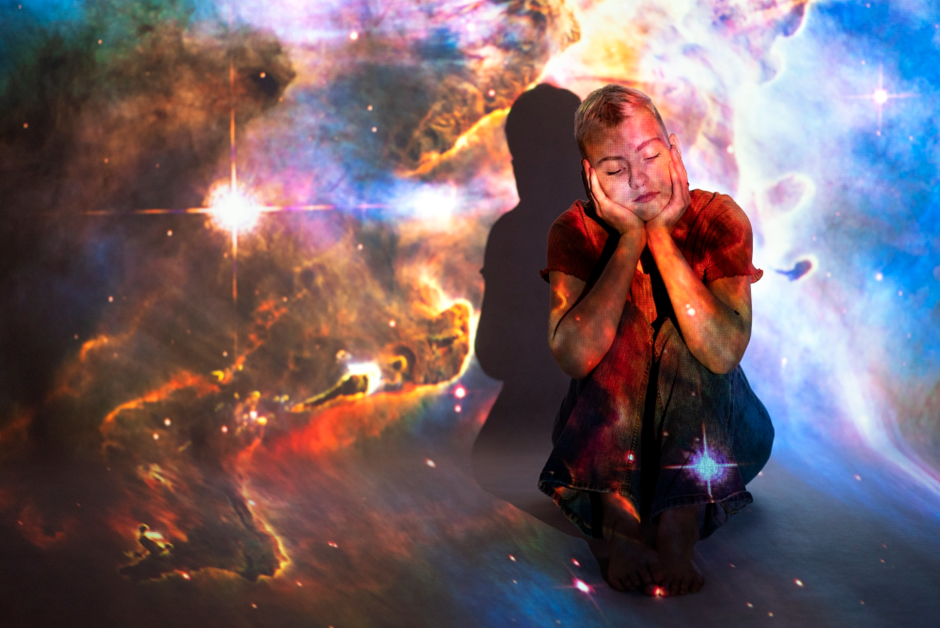
This has different interpretations. For centuries, we thought of singularity as the norm. But Reality is an infinite web of possibilities.
Where are these multiverses?
Is there a cosmic duplicate?
What does it mean for us?
The concept of infinite possibilities: –
Everett’s idea states that ‘Every choice I did not make is still created in another Universe.’
Could there be countless bubbles of universes, each holding a different world?
Can we connect to these universes?
Who am I?
I am only one version of this, according to Quantum mechanics. Some interpretations of quantum mechanics suggest that every choice creates another possibility.
Whenever anything occurs, the universe splits into many versions, and even the tiniest particles split into multiple versions, left and right, up and down. In one universe, we turn right; in another, we turn left-both happen simultaneously, like an endlessly expanding tree that creates countless branches.
All possibilities may exist—but we experience only one path. We do not meet the other versions of ourselves. But we cannot interact with each of these other universes-they are like pages in a book that do not overlap.
How do we define what is real? Or is nothing true?
Reality, I think, may not be singular—but layered.
-x-
Author’s Note / Disclaimer
This series of essays here in ‘Ink, the Mind’s Eye and Alchemy’ as well as in ‘ Quantum Questions’ explores ideas drawn from quantum mechanics, philosophy, spirituality, and personal reflection. While it refers to real scientific concepts—such as quantum uncertainty, probability, and observation—it does not claim to present formal physics or scientific proof.
Quantum mechanics is a precise and mathematical science. Whenever scientific ideas appear in these essays, they are simplified to help a general reader understand them. When the writing uses metaphor, reflection, or spiritual interpretation, it does so deliberately and openly.
The connections drawn here between quantum mechanics, consciousness, time, the soul, and spirituality are philosophical explorations rather than scientific conclusions. They reflect how these ideas have inspired my thinking and creative work, including my fiction.
I have used ChatGPT to help me proofread, edit, and rewrite my flow of thoughts into a more scientific and understandable form.
I have used Grammarly to enhance the final presentation.
The ideas presented evoke curiosity rather than certainty.
It asks questions instead of providing definitive answers.
My goal was to explore wonder, meaning, and possibility at the intersection of science and human experience.
What Is Science in This Work
- Descriptions of quantum mechanics as probabilistic
- Concepts like uncertainty, superposition, observation affecting measurement
- Relativity’s effect on time (time dilation, no single “now”)
- Atomic clocks, gravity affecting time
These are well-established scientific ideas, simplified for accessibility.
What Is Speculation
- Consciousness influencing reality beyond measurement
- Parallel universes as lived realities
- Near-death experiences as evidence of consciousness beyond the brain
- Future selves already “existing”
These are open questions and interpretations, not scientific facts.
What Is Philosophy / Spiritual Reflection
- Meaning of uncertainty in human life
- The soul as non-material
- God as underlying intelligence or order
- Time as experienced rather than measured
- Free will coexisting with determinism
These belong to philosophy, metaphysics, and spiritual traditions, especially Vedanta.
Why This Distinction Matters
Science explains how things work.
Philosophy asks what they mean.
Spirituality asks why they matter to us.
This work lives at the meeting point—not to blur boundaries, but to allow thoughtful conversation across them
-x-