


In reality, I am a student, trying to understand my own ‘stream of consciousness’.
Quantum Questions
Disclaimer: I am not an erudite scholar of Physics or of the great Indian scriptures. I am merely an inquisitive child trying to simplify and understand complex, extraordinary realities through the lens of everyday life. The following articles are my attempts to explain thoughts, concepts, and ideas that have always filled me with wonder.
The Soul as the Undying Principle
These Articles does not ask the reader to believe…
It invites wonder.n reality, I am a student, trying to understand my own ‘stream of consciousness’.
1.Science, Consciousness and the Mystery of Being
- ‘ SCHRÖDINGER’S CAT’— LIVING INSIDE UNCERTAINTY
I once read about an idea called ‘Schrödinger’s Cat’ in a book, and it stayed with me long after I closed the last page. Not because of complicated science, but because of how deeply it reflected life itself.
Despite its dramatic name, ‘Schrödinger’s Cat’ was never a real experiment. No cat was harmed. It was a thought experiment—an imagined story created to explain a strange truth about the universe at its smallest level.
2. THE THOUGHT EXPERIMENT, SIMPLY EXPLAINED: –
Imagine this:
A cat is placed inside a sealed box.
Inside the box is a tiny piece of radioactive material, a detector, and a vial of poison.
- If the radioactive atom decays, the detector releases the poison, and the cat dies.
- If it does not decay, the cat remains alive.
Here is where it becomes strange.
According to quantum physics, a radioactive atom is in a ‘superposition’—it is both decayed and not decayed at the same time until someone measures it.
In the same way, until someone opens the box, the atom in the box is considered to be both decayed and not decayed at the same time. Since the atom controls the poison, the cat is also described as both alive and dead simultaneously—not because this is physically happening, but because we do not yet know the outcome.
The moment the box is opened, and someone looks, uncertainty ends. The possibility becomes reality.
3. HOW IT CONNECTS TO LIFE: –
This strange idea mirrors how we live more than we realize.
1. Uncertainty Is Real
Like the cat, many things in life exist in a state of not knowing. Outcomes aren’t fixed until we face them. Our anxiety often stems from imagining all possibilities at once.
2. Observation changes reality.
In the experiment, looking alters the outcome. In life, attention does the same. What we focus on—fear, hope, love, anger—often shapes what unfolds.
3. We Live Between Possibilities
Living in “both states”, before results arrive, we often live as if success and failure are both possible. A diagnosis, an exam, a relationship, a creative work—until the moment arrives, all futures coexist in our mind.
4. The Danger of Never Opening the Box
Avoidance keeps us stuck. When we refuse to ‘open the box’—to ask the question, take the risk, face the truth—we remain trapped in imagined suffering rather than real experience.
5. Choice Creates Clarity
Life becomes clearer when we choose. Decisions collapse many possible futures into one lived reality. In essence, Schrödinger’s cat reminds us that uncertainty is not chaos- it is possibility. Choice collapses possibilities. Life becomes clearer when we act. Decisions collapse many potential futures into one lived reality.
Life, like quantum reality, becomes meaningful not in endless speculation, but in the courage to look, choose, and live fully once the box is opened.
QUANTUM MECHANICS — IN SIMPLE WORDS

- Reality as Possibilities: –
Quantum mechanics is the study of how very tiny things behave—things smaller than atoms don’t behave as we expect.
At this level:
At the smallest scale, nature does not behave in predictable, solid ways. Everything exists as potential until interaction or observation brings it into form. These rules feel unfamiliar only because reality itself is far more mysterious than common sense suggests, but they accurately describe how matter, energy, light, and even the building blocks of life truly behave.
- A particle can exist in two places at once, act like both a wave and a particle.
- Particles don’t behave like solid objects.
- They act like waves of possibility.
- They can exist in more than one state at the same time.
- Measuring them changes their behaviour.
Instead of certainty, quantum mechanics works with probability—what might happen rather than what will happen.
These ideas may feel strange, but they accurately describe how the universe works at its deepest level.
2. WHY QUANTUM MECHANICS FASCINATES ME: –
Quantum mechanics fascinated me so deeply that it became an idea I used in one of the stories in my soon-to-be-published book. In my story, scientists create a unique time machine based on quantum principles—where reality is not fixed, but fluid and full of possibilities.
3.THE SILENT PARTICIPANT: QUANTUM MECHANICS AND CONSCIOUSNESS
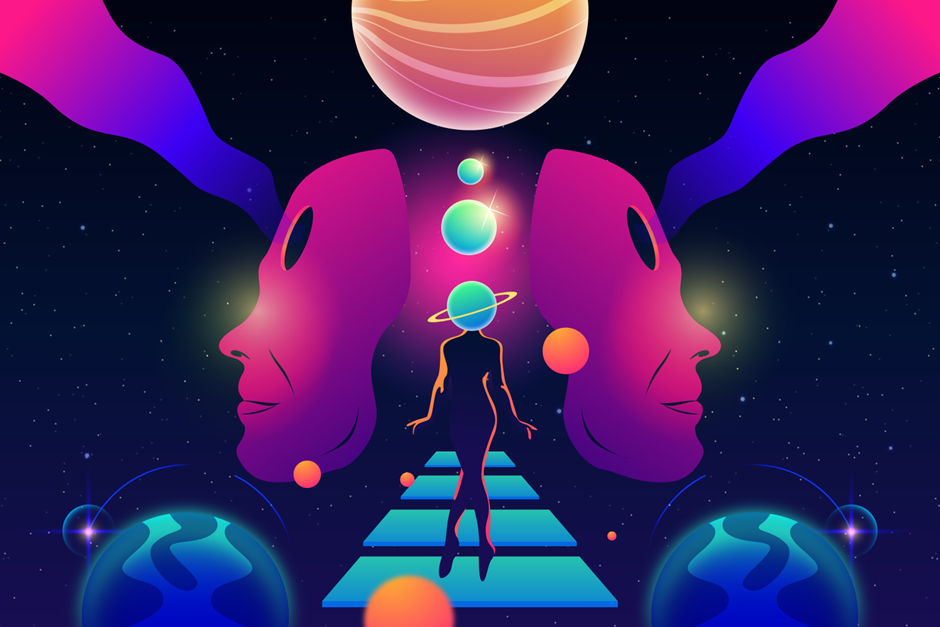
Quantum mechanics does not define God, but it humbles us by showing that reality is far deeper than our senses can grasp. In simple essence
Quantum experiments show that observation matters. This has led many thinkers to ask an important question:
Does awareness play a role in how reality appears?
This does not mean the human mind magically controls the universe. But it suggests that reality and awareness are closely connected.
In everyday life, consciousness works similarly:
- Our attention shapes experience. What we notice grows clearer; what we ignore fades.
- Choices collapse many possible futures into one lived moment—much like quantum possibilities collapsing into a single outcome. This doesn’t mean the mind magically controls the universe. Instead, it suggests that reality and awareness are deeply linked.
- Consciousness may not create the universe, but it participates in how the universe is experienced. It does suggest that the observer cannot be fully separated from what is observed.
- This has opened deep questions about whether awareness is a passive witness or an active participant in reality.
-x-
4: – SCIENCE, SPIRITUALITY, AND THE QUESTION OF GOD
Quantum mechanics reveals a universe that is interconnected, subtle, and governed by invisible laws. Nothing exists in isolation; everything influences everything else.
This echoes spiritual ideas of one underlying intelligence or order behind creation. God, in this view, is not a bearded figure in the sky, but the source of all laws, energy, and consciousness—the field from which particles, time, space, and life arise.
For many, this echoes spiritual ideas:
- One underlying intelligence
- One source of energy and order
- One field from which matter, time, space, and life arise
- God, for many, represents the ultimate intelligence behind both.
- Quantum mechanics says: reality is subtle, probabilistic, and interconnected.
- Consciousness says: awareness gives meaning to experience.
5: SCIENCE EXPLAINS HOW THE UNIVERSE BEHAVES. SPIRITUALITY ASKS WHY IT EXISTS AT ALL: –
Science explains how the universe behaves—through observation, measurement, and laws. It tells us how stars are born, why apples fall, how cells divide, and how time bends. Science seeks patterns, causes, and predictability, offering models that help us understand and shape the physical world.
Spirituality asks why it exists at all. It turns inward, questioning meaning, purpose, consciousness, and our place in the vastness. It wonders why there is something instead of nothing, why awareness arises, and why humans yearn for connection, love, and transcendence. Together, science and spirituality explore the same mystery—from different directions. They are not enemies. They are two ways of approaching the same mystery.
In Simple Essence
- Quantum mechanics tells us reality is probabilistic and interconnected.
- Consciousness gives meaning to experience.
- Spirituality asks why existence exists at all.
We live in a universe of possibilities.
We choose paths through awareness.
And life, much like quantum reality, becomes real when we observe, decide, and live.
6: – OPENING THE COSMIC BOX: A VEDANTIC REFLECTION ON REALITY, CHOICE, AND BEING
(I was always intrigued that our Indian philosophy had seemingly explained Quantum mechanics many centuries before it was understood in the present context.
The following article represents a few thoughts that I have penned. As stated earlier, I am not an erudite scholar of the Vedas. I have merely noted certain ideas encountered during my research. What is presented here represents only the very tip of an endless, bottomless iceberg. ChatGPT has assisted me with quotations from the scriptures.
I respectfully acknowledge the possibility of error in my interpretations and offer my apologies should any inaccuracies be found.)
What is real?
At the heart of both quantum mechanics and Indian philosophy lies this same ancient question.
The story of Schrödinger’s Cat begins with a box—closed, silent, filled with possibility. In Indian thought, however, this box can be read not merely as a scientific metaphor, but as the human mind itself—holding entire worlds within it, suspended between knowing and not knowing. ¹
In the Upanishads, reality is described not as fixed matter, but as potential—Brahman, the infinite ground from which all forms arise.
What we call the world is Maya: not illusion in the sense of falsehood, but reality experienced through limited perception. ²
Just as the cat remains uncertain until the box is opened, life too unfolds within Maya until awareness begins to dawn.
Superposition and Maya: Living Between Worlds
Quantum mechanics tells us that particles can exist in many states at once—like waves of possibility—until they are observed. Vedanta has long spoken, in its own language, of a similar human condition. ³
We live between:
- what we were
- what we might become
- what we fear
- what we desire
This is samsara—the state of becoming, of endless possibility and uncertainty.
As mentioned previously, an exam not yet written, a diagnosis not yet known, a relationship not yet named—we live as though all futures exist at once. Like a quantum particle, the mind remains in a kind of superposition, restless and anxious, until awareness collapses uncertainty into lived truth. ⁴
The Bhagavad Gita reminds us:
“You have the right to action, but not to the fruits of action.”
This is not resignation. It is wisdom—an invitation to act without clinging to outcomes, to open the box without fear of what we may find.
Observation, Awareness, and the Witness Self
In quantum experiments, observation changes what is known. In Vedanta, awareness itself is sacred. ⁵
Indian philosophy speaks of the Sakshi—the witness consciousness: the part of us that observes thoughts, emotions, fears, and joys without being consumed by them.
The mind fluctuates.
The world changes.
But the witness remains.
Quantum mechanics does not claim that consciousness creates the universe—but it does suggest that the observer and the observed cannot be completely separated. Vedanta goes a step further and quietly suggests:
You are not outside the universe looking in.
You are the awareness through which the universe is known.
When attention turns inward, the chaos of possibilities begins to settle. The unopened boxes of the mind open—not through force, but through clarity.
Indian philosophy has long held that the Atman—the soul—is neither born nor subject to death. It is not located in space, nor bound by time. ⁶
I spoke of the number 9—how it may disappear from paper, yet never vanish as an idea. Vedanta would agree.
The body disintegrates.
The mind quiets.
But consciousness does not simply switch off.
The Katha Upanishad says:
“The soul is not born, nor does it die. It is eternal, ancient, and everlasting.”
Accounts of near-death experiences, timeless awareness, and life reviews echo a similar intuition: that time belongs to the body and brain, while consciousness may not. ⁷
Time, Karma, and the Eternal Now
Modern physics tells us there is no single universal “now.” Time bends under gravity, motion, and perspective. Vedanta has long suggested that time is experienced within consciousness, not outside it. ⁸
In the idea of the’ Block Universe‘, all moments may already exist. In Indian thought, this finds a parallel in karma—not as rigid fate, but as a web of causes, tendencies, and possibilities.
The future exists as potential.
The past exists as memory.
The present is where awareness meets action.
We walk through life page by page, though the book may already exist. Yet—and this is crucial—we still choose how we read it. Determinism and free will are not enemies. They may be partners in the quiet dance of existence.
Parallel Universes and Indra’s Net
Some interpretations of quantum theory imagine branching universes in which every choice opens another path. Indian philosophy offers a luminous image for this: Indra’s Net.⁹A vast cosmic web, where at each node hangs a jewel—each reflecting all other jewels endlessly.
Every choice reflects countless others.
Every life mirrors infinite possibilities.
Nothing exists in isolation.
We experience only one path, one reflection—but the whole may still exist.
God: Not as Form, but as Field
In this journey, God appears not as a distant ruler, but as the intelligence behind order, the rhythm beneath randomness, the silence beneath sound.
Not a being among beings, but Being itself.
Quantum mechanics humbles us.
Vedanta steadies us.
Science explains how the universe behaves.
Spirituality asks why it exists at all.
Both bow before mystery.
Opening the Final Box
At the end of this exploration, we return to the box.
Life keeps offering us sealed moments:
- Will I speak or remain silent?
- Will I choose fear or faith?
- Will I act—or avoid?
Every unopened box holds imagined suffering.
Every opened box holds truth—whatever it may be.
Vedanta teaches that liberation (moksha) is not escape from life, but clear seeing.
Quantum mechanics reminds us that reality is not fixed until engagement.
Together, they whisper the same invitation:
Observe. Choose. Live.
For in opening the box,
we do not merely discover the cat—
we discover ourselves.
We are not passengers in a fixed universe.
We are participants in a field of possibilities.
Life becomes real when we observe, decide, and live.
-x-
Author’s Note / Disclaimer
This series of essays written here in ‘Quantum Questions’ as well as in the blog titled ‘Ink, the Mind’s Eye and Alchemy’ explores ideas drawn from quantum mechanics, philosophy, spirituality, and personal reflection. While it refers to real scientific concepts—such as quantum uncertainty, probability, and observation—it does not claim to present formal physics or scientific proof.
Quantum mechanics is a precise and mathematical science. Whenever scientific ideas appear in these essays, they are simplified to help a general reader understand them. When the writing uses metaphor, reflection, or spiritual interpretation, it does so deliberately and openly.
The connections drawn here between quantum mechanics, consciousness, time, the soul, and spirituality are philosophical explorations rather than scientific conclusions. They reflect how these ideas have inspired my thinking and creative work, including my fiction.
I have used ChatGPT to help me proofread, edit, and rewrite my flow of thoughts into a more scientific and understandable form.
I have used Grammarly to enhance the final presentation.
The ideas presented evoke curiosity rather than certainty.
It asks questions instead of providing definitive answers.
My goal was to explore wonder, meaning, and possibility at the intersection of science and human experience.
What Is Science in This Work
- Descriptions of quantum mechanics as probabilistic
- Concepts like uncertainty, superposition, observation affecting measurement
- Relativity’s effect on time (time dilation, no single “now”)
- Atomic clocks, gravity affecting time
These are well-established scientific ideas, simplified for accessibility.
What Is Speculation
- Consciousness influencing reality beyond measurement
- Parallel universes as lived realities
- Near-death experiences as evidence of consciousness beyond the brain
- Future selves already “existing”
These are open questions and interpretations, not scientific facts.
What Is Philosophy / Spiritual Reflection
- Meaning of uncertainty in human life
- The soul as non-material
- God as underlying intelligence or order
- Time as experienced rather than measured
- Free will coexisting with determinism
These belong to philosophy, metaphysics, and spiritual traditions, especially Vedanta.
Why This Distinction Matters
Science explains how things work.
Philosophy asks what they mean.
Spirituality asks why they matter to us.
(This work was written to allow for creative thoughts and conversations.)